
The latest statistics of the International Gas Association CEDIGAZ indicate that natural gas has pursued steady expansion. CEDIGAZ Survey Natural Gas in the World 2017 confirms the first estimates published early May, showing a 1.6% growth in global gas consumption in 2016, which is in line with the past five-year average. In recent years, the role of natural gas in the energy mix has slightly progressed, against the background of falling coal consumption and rising renewable energy production. Natural gas is expected to pursue similar growth trend in the short and medium term in the context of the energy transition towards an increasingly renewable-based, efficient and sustainable energy system.
Natural Gas Market - Page 9
India’s vision to a gas-based economy Drivers and Challenges
Thanks to India’s rising economy and population, the country’s outlook for growth in energy demand is robust. The role of gas in the country’s energy mix, however, is hard to determine. Today, India’s primary energy mix is dominated by coal and oil. The role of natural gas is limited: only 6% in 2016. But the government wants to make India a gas-based economy and raise the share of natural gas in the energy mix to 15% by 2022, although the timing remains uncertain. This paper analyses gas demand trends in India by 2025-30 and draws on two reports recently published by the Oxford Institute for Energy Studies (OIES) and the Bureau of Economic Geology (BEG)/Centre for Energy Economics (CEE), University of Texas.
Natural gas production, consumption and LNG imports in India (2000-2016)
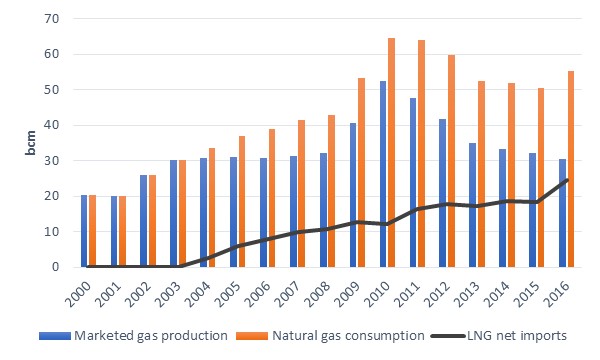
 Source: CEDIGAZ
NATURAL GAS DEMAND WILL PURSUE ITS SHORT AND MEDIUM-TERM GROWTH TRAJECTORY TO 2035, RISING AT A GRADUAL PACE OF 1.6%/YEAR.
CEDIGAZ, the International Association for Natural Gas Information, has just released its « Medium and Long Term Natural Gas Outlook 2017 ». This scenario, which incorporates national energy plans, highlights the growing role of natural gas as a key transition fuel towards an increasingly renewable-based, efficient and sustainable energy system. In this scenario, natural gas demand is expected to rise by 1.6%/year over 2014-2035 and its growth in absolute terms will outstrip that of all other energy sources. The strong expansion of LNG supply and the abundance of both conventional and unconventional resources will help gas to expand its role in the energy mix to the detriment of coal and oil. In a context of increased globalization of gas markets and diversification of natural gas supply, spot pricing will be a growing component for the commercialisation of gas. Many countries have policies that should favor gas consumption over other hydrocarbon sources, especially in the power sector. Coal-to-gas switching contributes to a strong decline in the future growth of carbon emissions. However, this will not be enough to reach the +2°C target: emissions in the Cedigaz scenario would put the world closer to a +3°C path.