
The global biomethane market is entering a new phase. Production continues to accelerate, but the most significant change is structural: biomethane is moving beyond a collection of regional markets, national support schemes and local applications towards an increasingly interconnected global commodity market.
CEDIGAZ’s new report, Global Biomethane Market – 2026 Assessment, examines this transformation and the forces reshaping production, demand, investment and trade. Regulatory changes, tighter climate targets, carbon pricing, energy-security concerns and delays in the deployment of low-carbon hydrogen are strengthening the role of biomethane across Europe, the Americas and Asia.
Global production continues to accelerate
Global biomethane production reached 10.1 billion cubic metres (bcm) in 2024, an increase of 17% year on year. Preliminary estimates put production at 12 bcm in 2025, representing further growth of 19%.
Production has doubled since 2020. At the end of 2024, more than 2,400 biogas upgrading plants were operating worldwide, with combined production capacity of approximately 13 bcm per year. The number of producing countries increased from 31 in 2020 to 41 in 2024.
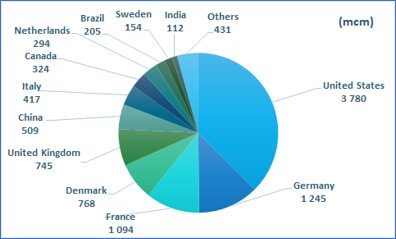
Europe and North America remain the industry’s main production centres and accounted for 88% of the additional output recorded in 2024. Europe produced 5 bcm, while the United States consolidated its position as the world’s largest individual producer, with output of 3.78 bcm.
Emerging markets are also expanding. China, India and Brazil are starting from relatively low production levels, but stronger policies, large feedstock resources and growing domestic demand are creating the conditions for much faster development.
Figure 1 – Evolution of global biomethane production (2010-2025)
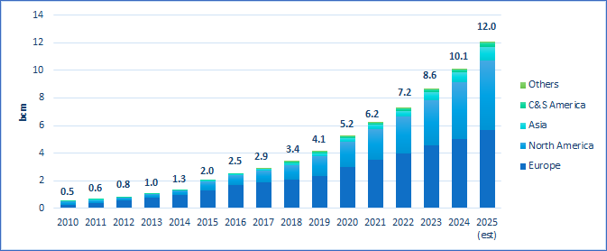
Figure 2 – Main biomethane producing countries in 2024
Demand is broadening beyond road transport
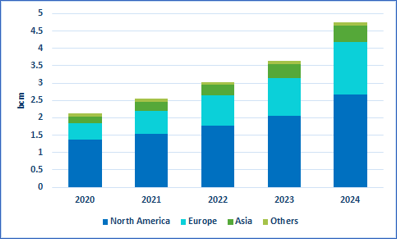
Road transport remains the largest biomethane market, accounting for 4.7 bcm of demand in 2024, or close to half of global consumption. Demand has grown rapidly as transport fuel mandates and fleet decarbonisation strategies have encouraged the replacement of conventional natural gas, diesel and other fossil fuels.
The regional outlook is nevertheless changing. The US road-transport market is approaching saturation, prompting producers to seek alternative outlets. By contrast, transport demand continues to offer significant potential in Europe, India and Brazil. European use of biomethane by natural gas vehicles increased by 42% in 2024 to 1.5 bcm, bringing biomethane’s share of total NGV gas consumption close to 40%.
Demand is now expanding into gas supply, industrial heat and maritime transport. Biomethane blending obligations have been adopted or proposed in several European countries, US states, Canadian provinces, Brazil, India, Japan and Singapore. Utilities are incorporating renewable gas into their decarbonisation strategies, while industrial companies are signing long-term biomethane purchase agreements to reduce emissions and exposure to carbon costs.
The slower-than-expected deployment and continued high cost of low-carbon hydrogen have reinforced this trend. Biomethane can be used immediately in existing gas infrastructure and equipment, making it a readily deployable option for hard-to-electrify industries while hydrogen and synthetic fuels mature.
Figure 3 – Biomethane demand by the transport sector – by region (2020-2024)
Maritime transport is creating an international bio-LNG market
Shipping has emerged as one of the most important new sources of demand. The entry into force of FuelEU Maritime in January 2025, combined with progressively tighter International Maritime Organization emissions rules, has strengthened the commercial case for LNG, bio-LNG and, ultimately, e-methane as a common fuel pathway.
Bio-LNG demand expanded sharply at European ports in 2025. Four major ports reported combined sales of approximately 287,000 tonnes, equivalent to around 400 million cubic metres of biomethane. A growing number of long-term supply agreements between shipowners, energy companies and bio-LNG suppliers are securing volumes for fleets operating across the main international shipping routes.
Existing LNG infrastructure gives bio-LNG a significant advantage. It can use the same liquefaction, transport, storage and bunkering assets, allowing the market to expand without waiting for an entirely new global fuel infrastructure.
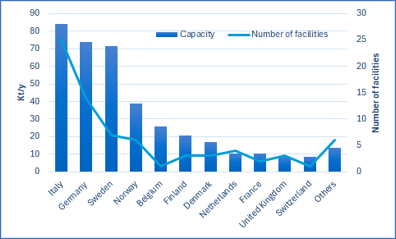
Europe currently has the most developed bio-LNG production base. At the beginning of 2026, its production capacity was estimated at around 270,000 tonnes per year, with a further 240,000 tonnes under development. Capacity is expanding particularly rapidly in Italy, Germany, Sweden and Norway.
Figure 4 – European bio-LNG capacity by country at the beginning of 2026
New trade flows are emerging across Asia
The globalisation of biomethane is progressing along two closely connected axes: the creation of an international marine bio-LNG market and the emergence of Singapore, Japan and South Korea as major importing centres.
Japan has already initiated regular bio-LNG imports from the United States and is investing upstream to secure future supply. Singapore’s Biomethane Sandbox is supporting imported biomethane for industrial, power and maritime applications, while its position as the world’s largest bunkering port makes it a natural hub for regional bio-LNG trade.
This demand is catalysing new production projects in Southeast Asia. Indonesia, Malaysia and Thailand have extensive agricultural and palm-oil residues, including palm oil mill effluent, which can produce biomethane with very low or potentially negative carbon intensity. Several projects and long-term contracts are targeting initial bio-LNG deliveries to Singapore from 2027.
The result is an emerging supply network linking North American producers, Asian agricultural markets and the principal gas and shipping hubs of Northeast and Southeast Asia.
A commodity market—but not yet a harmonised one
The growth of international trade does not mean that biomethane has already become a fully standardised commodity.
Its value increasingly comprises two components: the physical gas and its environmental attributes. Certificates and proof-of-sustainability systems allow biomethane’s carbon intensity, feedstock characteristics and methane-abatement benefits to be monetised separately from the molecule itself.
These attributes are critical to closing the cost gap with fossil natural gas and LNG. Their valuation, however, varies considerably between countries, end-use regulations and support schemes. European certification remains fragmented, while existing frameworks are not yet fully adapted to global trade or the decarbonisation needs of multinational companies.
The market is therefore globalising faster than its regulatory architecture. Further progress will require compatible registries, clearer carbon-accounting rules and greater mutual recognition of sustainability certificates.
Growth will remain below announced targets
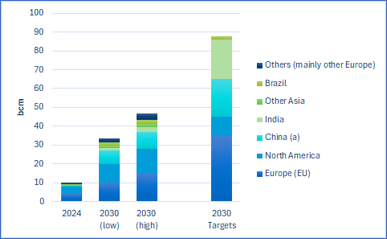
National and regional production targets together amount to approximately 90 bcm by 2030. These ambitions provide a strong signal to investors, but most countries remain well behind the trajectory required to achieve them.
CEDIGAZ estimates that a more realistic global production range is 33–47 bcm by 2030, compared with 10.1 bcm in 2024. This would still represent a three- to five-fold increase in six years, corresponding to annual average growth of between 22% and 29%.
Europe, North America and China will provide most of the additional production. EU output could reach 10–15 bcm by 2030, well below the 35 bcm REPowerEU target. North American production could rise to 10–13 bcm, while China could produce 7–9 bcm.
India and Brazil are also expected to record exponential growth from a smaller base. Indian production could reach 1.6–2.5 bcm by 2030, while Brazilian output could rise to 1.6–2.3 bcm. Southeast Asia could become another major production and export region, although the early stage of its policy and project development makes precise forecasting difficult.
Figure 5 – Outlook for RNG production in 2030 by region
Mobilising supply will be the decisive challenge
Demand for biomethane is developing rapidly, supported by increasingly diverse and international market outlets. The main constraints are now on the supply side.
High capital costs, lengthy permitting procedures, grid-access limitations, local infrastructure deficits and difficulties aggregating feedstock continue to slow project development. Sustainable feedstock potential is substantial, but mobilising it efficiently and at scale remains a major operational challenge.
The market’s expansion will depend on how quickly governments and industry can address these barriers. Clear long-term policy frameworks, effective demand-side incentives, improved infrastructure and internationally compatible certification systems will be essential.
Biomethane is already evolving from a regional renewable-gas market into a global decarbonisation fuel. Its future scale will be determined not by a lack of potential demand, but by the industry’s ability to convert abundant resources and announced projects into reliable, competitive and tradable supply.
Report details
Global Biomethane Market – 2026 Assessment: Towards a Global Commodity Market
Author: Sylvie Cornot-Gandolphe
Publisher: CEDIGAZ
Publication date: July 2026
Format: PDF, 131 pages
The report covers global and regional production data for 2024, preliminary estimates for 2025 and market and regulatory developments through 2025 and early 2026. It is accompanied by a database covering biomethane production, upgrading facilities and capacity in 41 countries from 2010 to 2024.