
By Irina Mironova for Cedigaz
In Part 1, we outlined the methodology used to identify vessels engaged in Russian LNG transportation and reviewed the structural characteristics of the fleet. In this second part, we turn to ownership structures and sanctions exposure.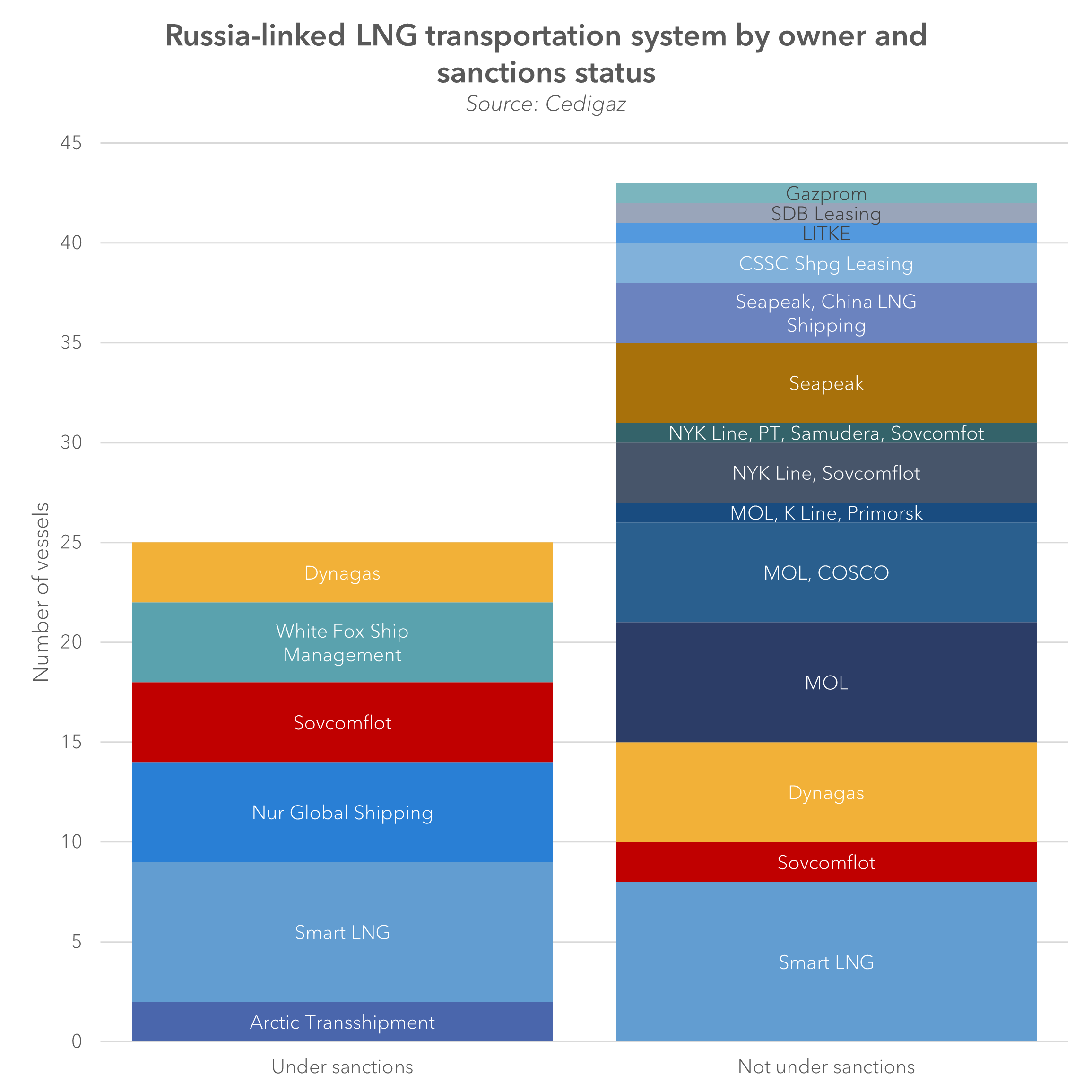
One of the findings from the dataset is that sanctions exposure is not evenly distributed across the fleet. Designated vessels are concentrated within a limited number of ownership platforms closely linked to Arctic projects or to sanctions-driven restructuring. By contrast, the non-designated segment is more fragmented and consists largely of established international shipping companies operating within long-term charter frameworks.
Group 1: Russian structures
Sovcomflot (PAO Sovcomflot), Russia
Sovcomflot, Russia’s largest shipping company and one of the key global operators in energy maritime transport, represents a central ownership pillar within the Russia-linked LNG fleet. More than 80% of its shares are controlled by the Russian Federation.
Within the Arc7 segment, Sovcomflot owns Christophe de Margerie, Boris Vilkitsky, and Boris Davydov, all operational Arc7 vessels serving Yamal LNG. In the conventional segment, it owns Valera and Perle, which followed identical Liberia → Gabon → Barbados → Comoros → Oman registry transitions and now operate under the Omani flag, as well as La Perouse, which ultimately reflagged to Russia. Sovcomflot also holds co-ownership positions in Tangguh Batur and Tangguh Towuti, and in the Sakhalin LNG carriers Grand Elena and Grand Aniva.
Sovcomflot as a corporate entity has been sanctioned by Canada, the United States (sectoral restrictions in 2022 and blocking sanctions in 2024), the European Union, the United Kingdom, Switzerland, Australia, Ukraine and New Zealand. Within the LNG fleet, Christophe de Margerie, Valera, Perle, and La Perouse are designated, while other Arc7 vessels such as Boris Vilkitsky and Boris Davydov are not.
Smart LNG, Russia
Smart LNG, established in September 2019 as a joint venture between Novatek and Sovcomflot, represents the dedicated shipowning platform for the Arctic LNG 2 Arc7 carrier programme. The company is responsible for a series of 172,600 m³ ice-class LNG carriers contracted under long-term charter agreements for Arctic LNG 2 and constructed at the Zvezda Shipbuilding Complex. One vessel – Aleksey Kosygin (Zvezda 041) – is operational, while fourteen additional Arc7 units (Zvezda 042 through Zvezda 055, including Pyotr Stolypin, Sergei Witte and others) remain under construction. All vessels are Russian-flagged and classed Arc7. A first tranche of seven units (Zvezda 041–047) is subject to U.S. (OFAC) sanctions imposed on 6 December 2024, while the remaining hulls (Zvezda 048–055) are not.
Arctic Transshipment, Russia
Arctic Transshipment, a subsidiary of Novatek, operates two floating storage units, Saam FSU and Koryak FSU, both built in 2023 and currently operational. Saam FSU is registered under the Russian flag following a Panama-to-Russia transition and is stationed near Murmansk, while Koryak FSU, previously under Panama registry, is currently listed with unknown flag status and is positioned at Kamchatka. Both units are subject to EU and U.S. (OFAC) sanctions. Both are important elements of the Arctic transshipment infrastructure.
Group 2: Sanctions-adaptive structures
Nur Global Shipping, UAE
Nur Global Shipping emerges as one of the most structurally opaque ownership platforms within the Russia-linked LNG segment. The Dubai-based company controls five conventional (non-ice-class) LNG carriers: Arctic Vostok, Arctic Metagaz, Arctic Pioneer, Arctic Mulan, and Nova Energy. All vessels are operational. The first four sail under the Russian flag, while Nova Energy is currently registered in Curaçao. A defining feature across this cluster is complex registry sequencing prior to Russian reflagging or repositioning, typically involving Liberia and Palau as intermediary jurisdictions (e.g. Liberia → Palau → Russia; Norway → Singapore → Liberia → Palau → Russia; Bahamas → Singapore → Palau → Russia). Nova Energy followed Greece → Liberia → Palau → Panama → Curaçao. Each vessel has an extensive renaming history, and all five are designated under multiple sanctions regimes, including the EU, UK (OFSI), US (OFAC), Canada and Switzerland, with additional listings for Australia and New Zealand in specific cases.
The Nur Global Shipping cluster aligns more closely with patterns commonly associated with sanctions-adaptive or shadow-fleet logistics: newly established Dubai-linked ownership, multi-stage flag transitions, frequent renaming, and jurisdictional layering prior to final deployment. The 2024 Bloomberg reporting referenced Dubai free-zone shell structures as instrumental in obscuring beneficial ownership, particularly in relation to Arctic LNG 2 exports.
White Fox Ship Management, UAE
White Fox Ship Management, a UAE-based company, appears in the dataset as the manager of four Arc4 ice-class LNG carriers: Buran, Voskhod, Zarya and Iris. All four vessels were built in 2023–2024 with a capacity of 174,000 m³ at Samsung Heavy Industries and are currently operational under the Russian flag. They were originally delivered under the “North” naming convention (North Air, North Mountain, North Way and North Sky) before being renamed. According to available information, these vessels were initially associated with the Arctic LNG 2 shipping programme and reportedly linked to structures involving NYK Line and Sovcomflot but were subsequently transferred to White Fox Ship Management. In summer 2024, they received authorization to navigate the Northern Sea Route and have since been involved in LNG transshipment operations connected to Yamal LNG flows.
All four vessels are designated under multiple sanctions regimes, including the EU, UK (OFSI), US (OFAC), Canada and Switzerland, with Iris additionally listed by New Zealand. Within the broader fleet structure, this cluster represents a newly built, ice-class segment that was reallocated into Arctic-linked logistics under a different management platform.
Group 3: European connections
Within the operational Arc7 segment of the Yamal LNG fleet (built at DSME, now Hanwha Ocean, between 2017 and 2019, each with a capacity of 172,000 m³), ownership is heavily concentrated among internationally established LNG shipping companies, most notably Seapeak and Dynagas.
Seapeak, UK
Seapeak – historically headquartered in the United Kingdom (Seapeak Maritime Glasgow) – controls or co-controls a significant portion of the operational Arc7 tonnage. This includes Eduard Toll, Rudolf Samoylovich, Georgiy Ushakov, as well as jointly held vessels Yakov Gakkel, Vladimir Voronin, and Nikolay Yevgenov (in partnership with China LNG Shipping). None of the Seapeak-linked Arc7 vessels are designated under sanctions. Public reporting indicates that Seapeak intends to migrate Russian vessel operations from the UK to Singapore ahead of the 2027 services ban, while simultaneously expanding its global LNG newbuilding programme, including recently contracted 174,000 m³ carriers at Samsung Heavy Industries for U.S. export trades.
Dynagas, Greece
Dynagas, a Greece-based LNG maritime transportation company established in 2004, represents the second major operator within the Arc7 cluster. The company operates Fedor Litke, Georgiy Brusilov, and Nikolay Zubov, all DSME-built Arc7 vessels sailing under the Cyprus flag and currently not designated under sanctions.
Group 4: Asian connections
Mitsui O.S.K. Lines (MOL), Japan
Mitsui O.S.K. Lines (MOL) occupies a structurally significant position within the Russia-linked LNG transport system, spanning Arc7 ice-class carriers, Arc4 seasonal support tonnage and conventional LNG vessels participating in Kildin transshipment chains. In the Arc7 segment, MOL is linked to Vladimir Vize, Vladimir Rusanov and the jointly owned Nikolay Urvantsev (with COSCO), all DSME-built vessels of 172,000 m³ capacity and currently operational.
Within the Kildin transshipment chain, MOL and MOL/COSCO control the 174,000 m³ Hudong Zhonghua-built vessels LNG Phecda, LNG Megrez, LNG Merak and LNG Dubhe, none of which are designated under sanctions. In addition, MOL owns the 2024-built Arc4 vessels North Ocean, North Moon, North Light and North Valley (Hanwha Ocean), which were deployed in Yamal-linked trades via ship-to-ship transfer with Arc7 carriers. North Moon, North Ocean and North Light were included in the EU’s 17th sanctions package in May 2025 but were subsequently delisted following commitments not to serve Yamal LNG and Arctic LNG 2 projects.
At the same time, three 2025-built Arc7 vessels – Ilya Mechnikov, Nikolay Semenov and Nikolay Basov – are currently recorded as stranded in South Korea.
NYK Line (Nippon Yusen Kaisha), Japan
NYK Line (Nippon Yusen Kaisha) appears as a long-standing commercial participant in Russia-linked LNG logistics through structured joint ventures (not direct Arctic fleet ownership). Within the Yamal-linked segment, NYK is associated with Tangguh Batur (2008, 145,700 m³, DSME, Singapore flag), co-owned with Sovcomflot, and Tangguh Towuti (2008, 145,700 m³, DSME, Singapore flag), owned in a consortium including NYK, PT Samudera and Sovcomflot. Both vessels are conventional (non-ice-class) LNG carriers and remain operational without sanctions designation.
NYK is also linked to Grand Elena and Grand Aniva (2007-2008, Cyprus flag), both co-owned with Sovcomflot and operational. These vessels are structurally distinct from the Arc7 Arctic fleet and reflect legacy long-term project shipping arrangements tied to Sakhalin 2 LNG supplies to Japan.
Conclusion
The Russia-linked LNG fleet does not constitute a unified shadow fleet. Instead, it comprises:
- A sanctioned Russian core (Sovcomflot, SMART LNG, Arctic Transshipment)
- A sanctions-adaptive restructuring layer (Nur Global Shipping, White Fox)
- A substantial internationally integrated commercial segment (Seapeak, Dynagas, MOL, NYK)
Sanctions exposure is concentrated in specific ownership clusters tied to Arctic LNG 2 and restructuring activity, while a significant share of the fleet remains embedded in transparent, globally established LNG shipping structures.