
Africa’s gas sector is drawing more attention, as recent activity and announcements by the majors show. A broader LNG supply frontier is taking shape, and the continent’s own gas market is becoming more visible.
Established exporters such as Algeria still account for most of Africa’s operating liquefaction capacity, but the next wave of projects sits with newer suppliers: Mozambique, Senegal-Mauritania, Congo, Nigeria’s expansion and, potentially, Tanzania. Since the Gulf disruption began, North American supply has partly offset lost Qatari and Emirati volumes, and buyers are now looking for alternatives from West Africa to Indonesia. Africa is not only an upstream appendage for Europe and Asia, however. Import terminals, regional pipelines and domestic gas obligations point to the gradual formation of more connected African gas markets.
This series looks at Africa’s role in the global gas market along three dimensions:
- Africa as one of the world’s gas supply frontiers.
- International companies building diversified African gas portfolios.
- A continental gas market emerging alongside exports.
Part 1 covers supply for external markets.
Part 1: A New Generation of African LNG Suppliers
Africa remains one of the world’s largest gas supply frontiers. The continent operates around 80 Mtpa of LNG capacity, another 25 Mtpa is under construction, and around 140 Mtpa is at potential or speculative stages. Recent months show that this frontier is moving on several tracks at once, and that the binding constraint differs by region.
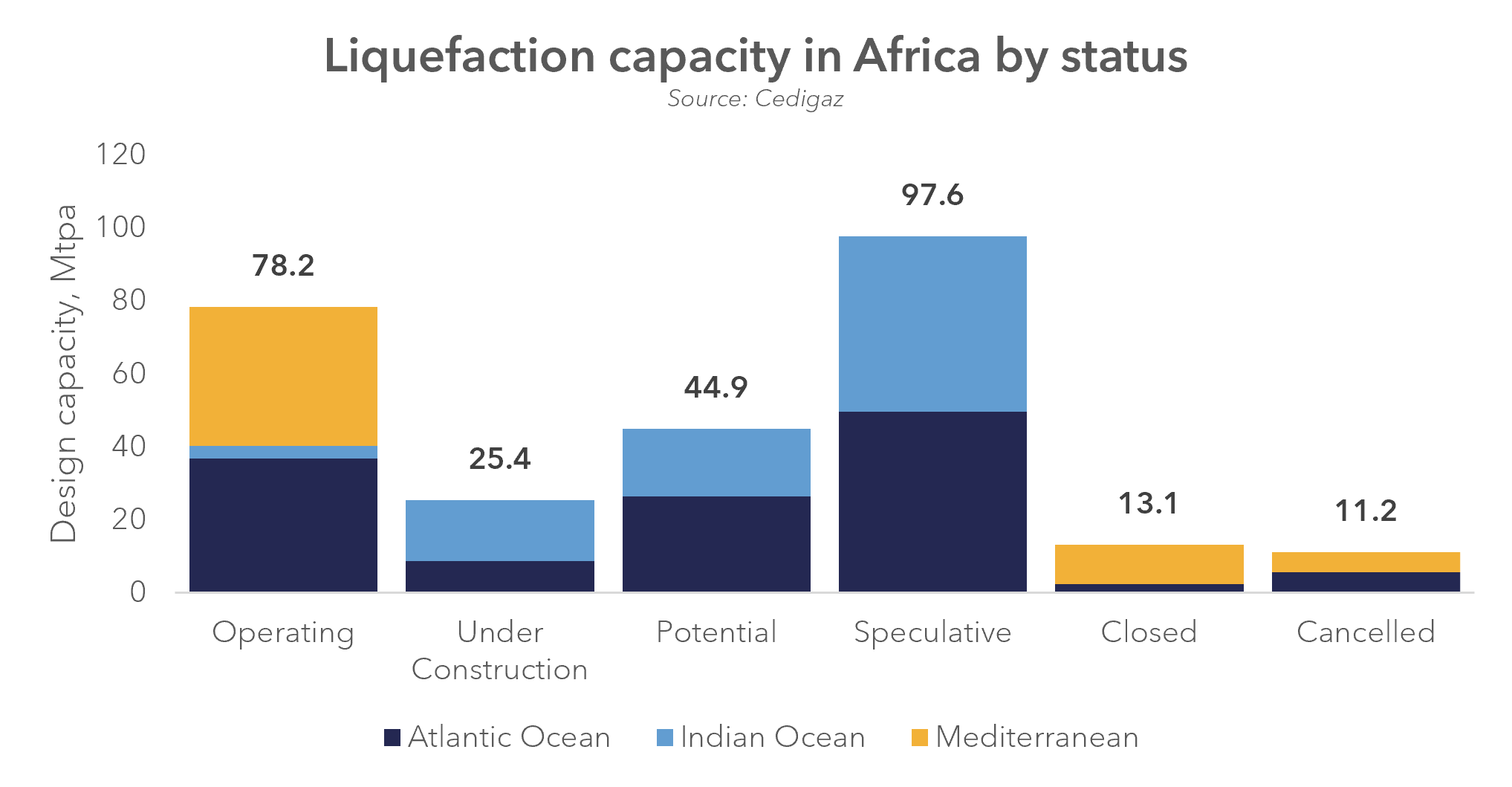
North Africa, facing the Mediterranean, holds the largest share of operating liquefaction capacity (38 Mtpa), followed by the Atlantic coast (36.8 Mtpa). Coral South FLNG in Mozambique is the only operating project on the Indian Ocean. Among projects under construction, potential and speculative, the Indian Ocean leads.
North Africa: capacity without surplus
North Africa has liquefaction capacity in Algeria, Egypt and Libya. It is almost a separate gas system: pipelines already connect it to Europe, shipping distances are short and upstream is mature. The three countries now share one constraint, rising domestic demand, but it plays out differently in each.
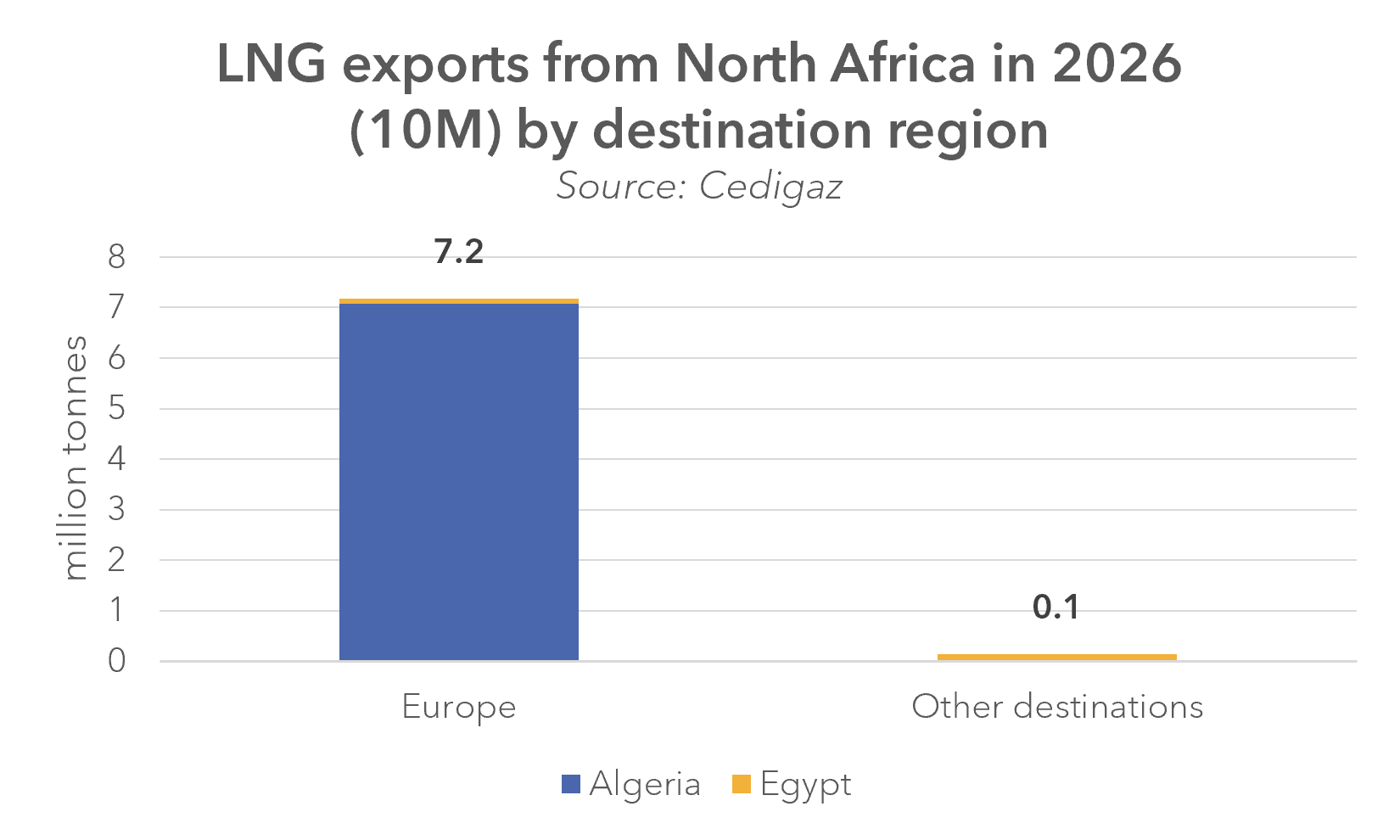
Algeria remains the anchor supplier, with the Arzew and Skikda plants in operation. It exports roughly three times as much gas by pipeline as it does as LNG (2025, Cedigaz). Algeria provided 34% of Spain’s gas between January and July 2026, through the Medgaz pipeline and LNG (LNG Journal). Sonatrach delivered its first LNG cargo to Germany’s Wilhelmshaven terminal in July (LNG Prime), and Germany’s foreign minister has since travelled to Algiers seeking long-term gas contracts. The constraint is on the supply side: producing fields are mature, domestic demand is rising, and the export surplus is being squeezed. Sustaining exports depends on new upstream investment.
Egypt has moved to the other side of the balance. Over the past two years, declining output from mature offshore fields has coincided with rising power-sector demand, particularly in summer. Gas has proved insufficient to supply power generation, industry and liquefaction at the same time. Domestic supply took priority, leading to repeated curtailments and temporary shutdowns at Idku and Damietta in 2023–2024. In 2025, Egypt was Africa’s largest importer of both LNG and pipeline gas (Cedigaz).
Egypt has not abandoned exports. The last export cargo left Idku in August 2026 and July imports reached a record 24 cargoes (LNG Journal), but the liquefaction plants are set to process Eastern Mediterranean gas. The Cronos development offshore Cyprus, sanctioned in July, will route gas through Zohr and Damietta from 2028, principally for LNG export; its output “should not be treated as 14.2 million m3/d guaranteed to Egyptian consumers” (Oilprice). Analysts describe Idku and Damietta as “a balancing mechanism rather than a profit centre” (LNG Journal).
Libya hosts the third liquefaction plant ever built, after Arzew and Kenai, but Marsa El Brega LNG is currently non-operational. Libya is targeting about 40 bcm/y (4 bcf/d) of gas output within three to five years, up from gross production of 28 bcm in 2025 (Cedigaz). In the meantime, the Brega terminal is being considered for conversion to LNG imports to replace liquid fuels in power generation (see also an earlier World Bank report).
North Africa holds the largest liquefaction capacity but lags the Atlantic coast in exported volumes: 7.3 Mt so far in 2026, against 26 Mt from Atlantic exporters (Cedigaz). Arzew, with about 20.8 Mtpa of capacity, is reported to be operating below capacity; Egypt prioritises domestic supply to the power sector; and Libya exports below 1 bcm/y by pipeline while considering LNG imports. All three face growing domestic demand, and in Algeria a depleting production base adds to the pressure.
Atlantic: expansion constrained by feedgas
This group covers the current LNG exporters whose plants supply the Atlantic basin: Nigeria, Angola, Equatorial Guinea, Mauritania/Senegal, Congo and Cameroon. Their exports serve both European and Asian buyers. In 2025, the split was close to even, with Europe slightly ahead. In 2026, with the Hormuz crisis and an arbitrage favouring Asia for most of the year, Asia became the main destination for LNG from Africa’s Atlantic coast.
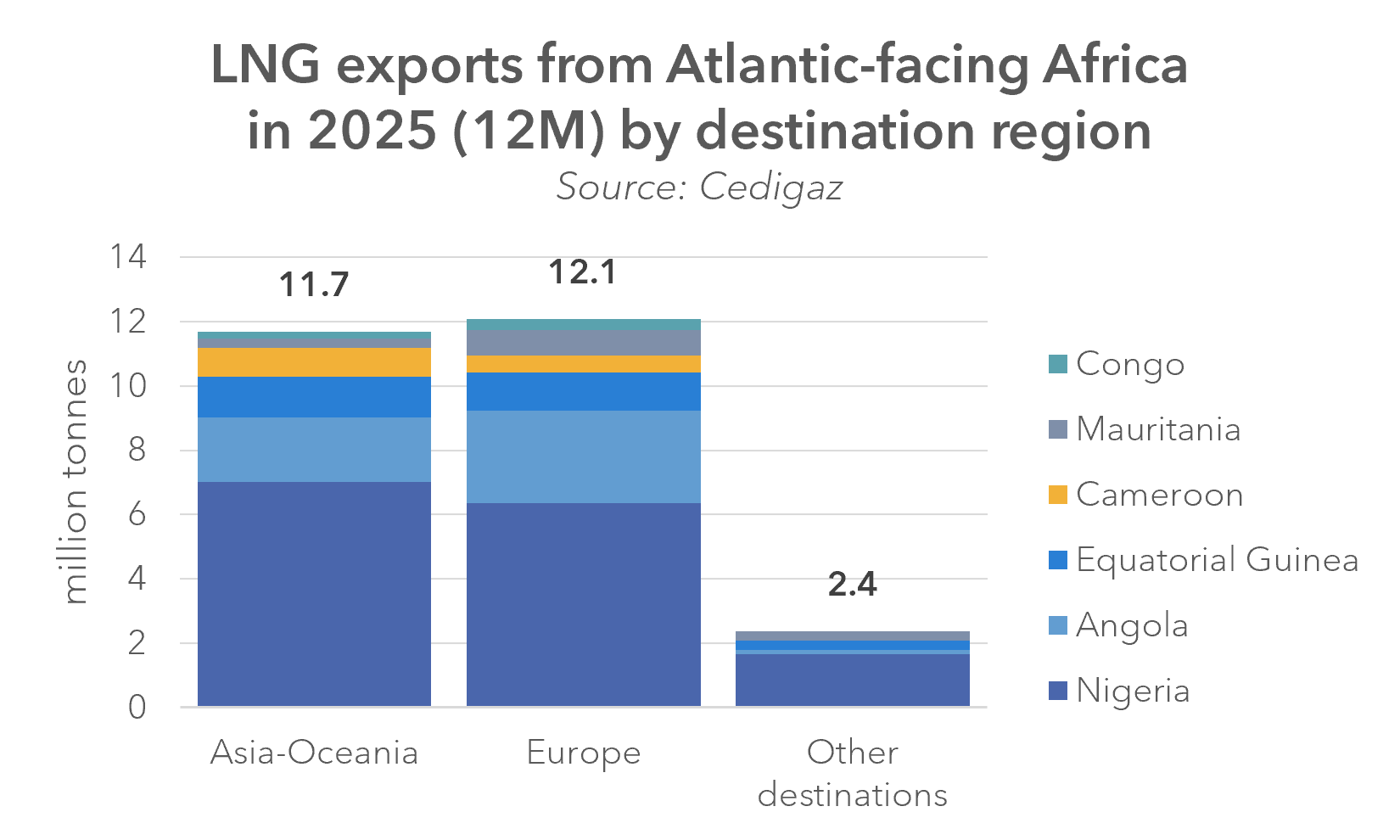
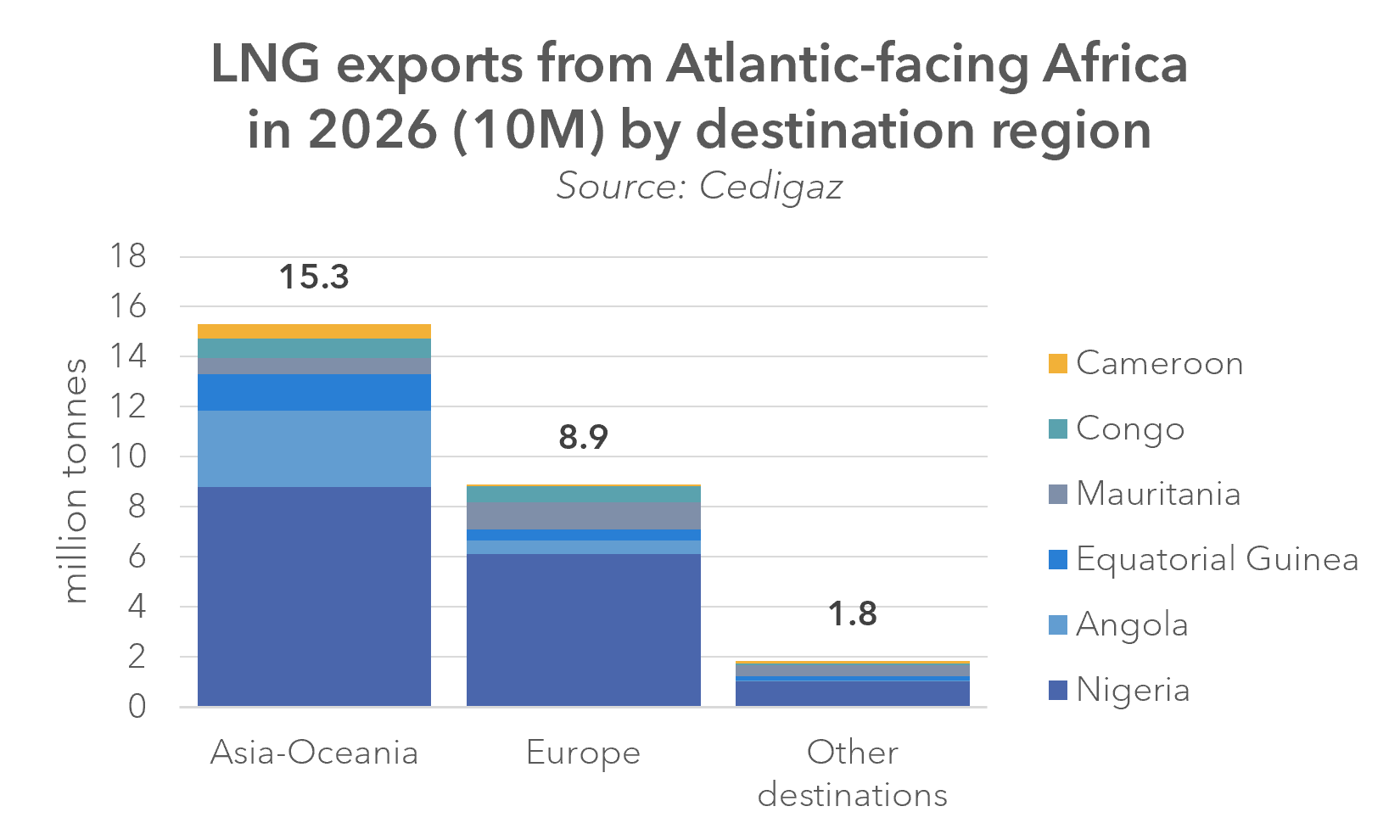
Nigeria is Africa’s largest LNG exporter and, counting LNG and pipeline gas together, its second-largest gas exporter after Algeria. NLNG Trains 1–6 provide 22.2 Mtpa of operating capacity. Train 7 is about 93% complete and targets start-up by end-2027, lifting Bonny Island capacity to about 30 Mtpa (LNG Prime), and NLNG has begun exploratory work on Trains 8 to 10. Yet the existing plant runs at 83% utilisation and remains under force majeure imposed after the 2022 flooding; the managing director states that “our biggest constraint is gas supply” (LNG Journal). Two feedgas commitments followed:
- TotalEnergies and AMNI have taken FID on the Ima gas field, which from 2028 will supply about one-third of the gas required for Train 7, at a plateau of 350 mmcf/d (about 3.6 bcm/y).
- UTM Offshore’s Yoho floating LNG project has secured a 15-year feedgas agreement for 200 mmcf/d (about 2.1 bcm/y) with the NNPC/Seplat joint venture, with FID targeted for autumn 2026 (LNG Prime).
Equatorial Guinea shows the same constraint at a mature plant. Feedgas from Alen and Alba (about 175 mmcf/d or 1.8 bcm/y) falls short of Punta Europa’s liquefaction capacity, and the plant exported no cargoes for three consecutive weeks in October. The response is aggregation: Chevron’s Aseng tieback (first gas 2028) and the Yoyo-Yolanda fields unitised with Cameroon would route additional gas to the existing plant (Wood Mackenzie).
Floating liquefaction has become the entry route for newer Atlantic producers:
- Greater Tortue Ahmeyim (Senegal-Mauritania) lifted nine cargoes in the second quarter and produced above its 2.7 Mtpa nameplate in the first quarter (LNG Prime).
- Congo LNG now runs two FLNG units with 3 Mtpa of capacity (LNG Prime).
Floating capacity is also mobile. The Hilli Episeyo FLNG left Cameroon after eight years and is being upgraded for redeployment to Argentina (LNG Industry).
Upstream activity continues beyond the current exporters. In Angola, the Katambi-2 well delivered the country’s first full flow test on a non-associated gas reservoir, at 41 mmcf/d (0.4 bcm/y) with potential above 100 mmcf/d (1 bcm/y, Oilprice). In Côte d’Ivoire, the Baleine development continues to draw new partners, including SOCAR, and Petrobras has added eight exploration blocks (Offshore Energy).
Indian Ocean: the largest greenfield opportunity, at a higher cost
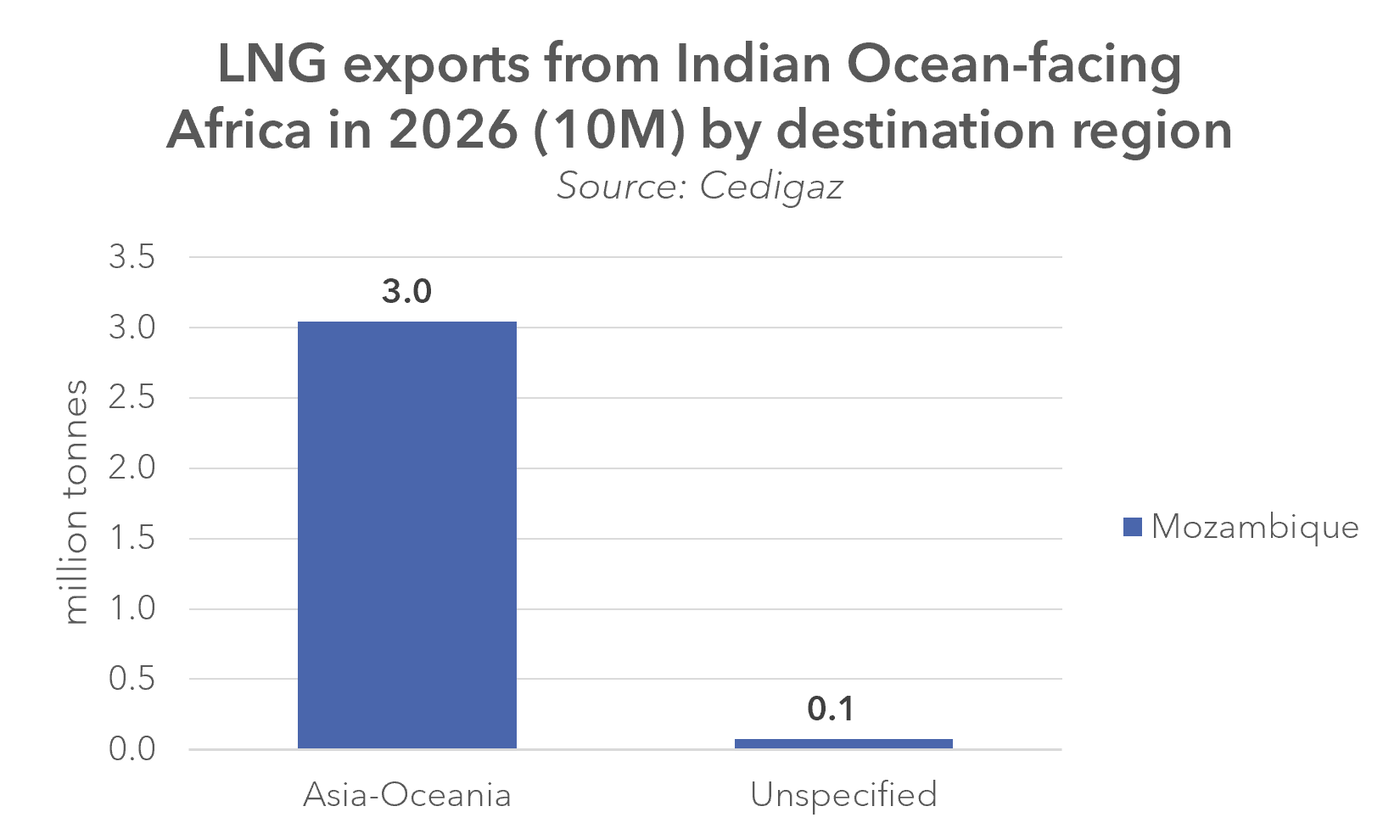
The Indian Ocean coast currently exports little (Mozambique only, 3.1 Mt so far in 2026, almost all to Asia-Oceania), but it holds the largest greenfield LNG opportunity.
Two projects in Mozambique are now in execution or pre-execution:
- Construction at TotalEnergies’ 12.8 Mtpa Mozambique LNG restarted in January and is about 45% complete, targeting a first train in 2029. Part of its equipment was built in Middle Eastern yards and faced difficulties leaving the region during the conflict (LNG Prime).
- ExxonMobil’s 18.6 Mtpa Rovuma LNG is targeting FID by year-end (LNG Prime). Partners have awarded about USD 1.1 billion in pre-investment contracts (ExxonMobil), and total capex has risen to about USD 30 billion from earlier estimates of USD 20–25 billion, with first LNG targeted for 2031 (LNG Journal).
Eni’s Coral Norte FLNG unit, of 3.5 Mtpa, is also under construction.
Tanzania is back on the agenda. The government says it is close to finalising agreements on the USD 42 billion project (Reuters), and Equinor is considering reviving it with Shell. An Equinor executive describes the attraction as producing LNG “in an area which is not exposed to these kinds of geopolitical challenges” (LNG Journal).
Conclusion
Africa’s supply frontier is expanding, but not uniformly. In North Africa, rising domestic demand absorbs export capacity; on the Atlantic coast, the constraint is feedgas; in Mozambique, it is cost and execution. Floating units have lowered the entry threshold for new producers, but they can also leave.
The more interesting question is who is positioning to develop these resources. That is the subject of the next post in this series.
By Irina Mironova for Cedigaz