
International Gas Prices – June 3 , 2015

NBP: a significant decrease
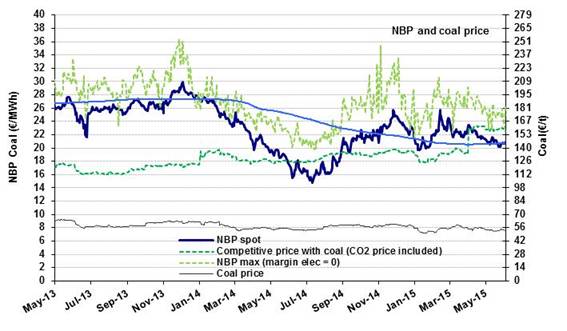
NBP and Coal priceThe average NBP price fell by 5.5% in May to €20.9/MWh ($6.8/MBtu). So far, the overall downtrend observed since mid-February has not been as steep as it was last year. In May 2014, the price average stood at €19/MWh ($7.6/MBtu), i.e. 10% lower than in May 2015.

Nor are forward markets anticipating a downtrend for the next few months as sharp as that occurring in 2014, with the NBP falling below €17/MWh ($6.8/MBtu) between June and August. The forecast is that prices will slip to €19.8/MWh ($6.6/MBtu) during the summer.
International Gas Prices – May 7 , 2015

NBP: A return of the 2014 scenario?

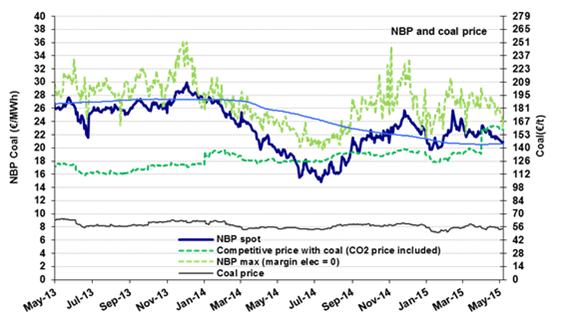
NBP and Coal priceThe NBP price averaged €22.1/MWh ($7.0/MBtu) in April, down by 1% over March. There is greater downward pressure on the quotations for early May, which are at €20.9/MWh ($6.8/MBtu), close to the levels predicted by the markets for this summer (€20.4/MWh on average). A return of the 2014 scenario, with its sharp drop in prices during the summer (€16-17/MWh between June and August 2014) remains possible this year: demand is lower than in the past, especially in the power sector (20 bcm since 2012 compared to 30-35 bcm before then; the market share for natural gas has fallen from 41% in 2011 to 29%; renewable energies are up from 9 to 17%).

International Gas Prices – April 3 , 2015

NBP: Long-term and spot prices converging in 2015?

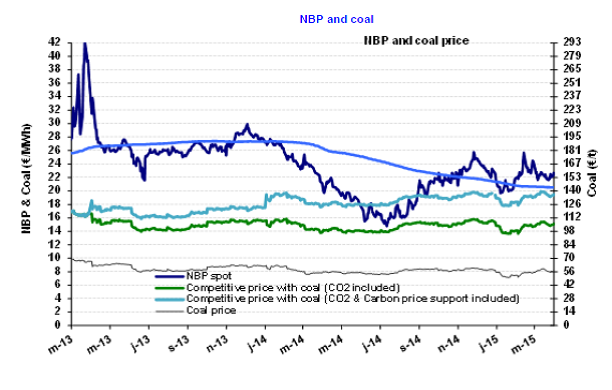
NBP and coal graphiqueThe NBP price averaged €22.3 /MWh ($7.1/MBtu) in March, down 4.5% over February. The average for winter 2014-15 was roughly the same (€22.5/MWh), lower by 16% than that of the previous winter. So concerns over supply (Russia versus Ukraine, uncertainty over Groningue, the storage capacity at Rought) have not had a structural effect on prices.

In upcoming months, the market is anticipating an average price of €21.5/MWh ($6.7/MBtu) for next summer and €24/MWh ($7.6/MBtu) for next winter. Based on the current forecasts, these levels are moving towards convergence with the prices of oil-indexed contracts. If the trend persists and convergence occurs, this would represent a break with the situation observed since 2009. Between 2009 and 2014, the indexed prices served as a ceiling for the NBP, whose prices were systematically lower.