Latest developments of the Egyptian gas industry

Egyptian marketed natural gas production has been steadily declining since 2009, as a result of the depletion of offshore mature gas fields and delays in new offshore developments (West Nile Delta), exacerbated by the political unrest. This downturn accelerated in 2013 (- 6%) and even further in 2014 (- 14%). In 2015, marketed production is estimated down 8.9% to 44.5 bcm, according to Cedigaz provisional estimates.

In a context of production shortfall, natural gas consumption declined from 52 bcm in 2013 to 48 bcm in 2014. In 2015, natural gas consumption stabilized despite the production decline as Egypt started importing gas after soaring power demand forced it to halt LNG exports.

International Gas Prices – May 11 , 2016

NBP: influenced by the LNG and oil markets

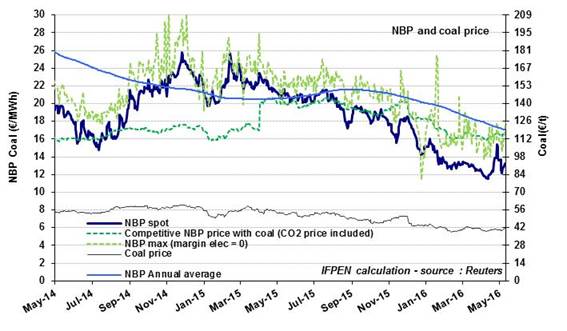
NBP and coal price GraphIn April, the NBP saw fairly marked fluctuations, ranging from +18% to -10% compared to the monthly average. In a temporary surge, it exceeded €15/MWh ($5/MBtu) on April 26 and 27. A situation of momentarily sustained demand coincided with deficiencies of supply, resulting in heavy recourse to storage. However, monthly averages have been more stable since February, between €12.7-13/MWh ($4.2-4.3/MBtu). The price for early May and the forward quotations for the summer months (until September) stand at about the same levels. Obviously, lower prices cannot be excluded, in light of the market equilibrium conditions. On April 11, the price fell to €11.5/MWh ($3.9/MBtu), its lowest level in recent months, in step with the conditions prevailing on the LNG market in Europe at that time.

2015: A Third Year of Moderate Growth in Gas Demand

Natural gas demand grew by 1.6% in 2015 according to Cedigaz after having stagnated in 2014. However, this apparent, if modest, resumption of global gas market growth can be misleading as the higher growth rate is essentially the result of a weather driven recovery in the EU where demand rebounded by 4.5% after having dropped by 11% in 2014. For the rest of the world gas demand growth was actually lower than in 2014 (1.2% vs. 2%) and was pulled by a limited number of countries led by the US. The inability of natural gas demand to keep pace with an accelerated supply growth, led to an imbalance in the global gas market and to a price weakness which is expected to continue in the short and medium-term, amid a sluggish economic environment.

The year 2015 saw considerable changes in macroeconomic and price factors. Economic growth stood at 3.1%, lower than at any time since 2012 (3.3/3.4%) and also lower than the 10‐year trend (3.8%). This was the result of the relatively modest growth of the emerging countries (4% compared with 6% over ten years), although western countries’ growth rate exceeded the 10‐year average (1.9% compared to 1.5%).  International crude oil prices fluctuated to new lows, with Brent averaging 52/bl, down by 47% from the previous year.