Quarterly report on Natural gas prices (Q1 2018)

Global trends

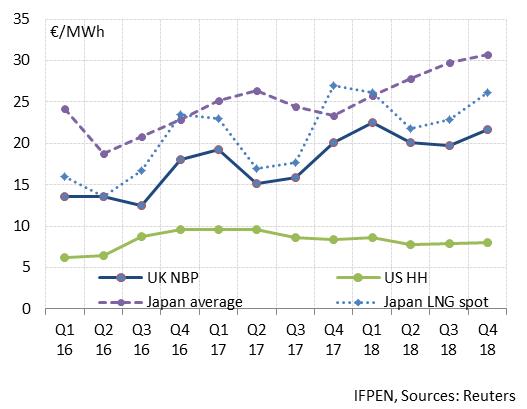
Gas prices rose in Q1, mainly owing to a harsh winter (Fig. 1). Since then, they have declined, as is usually the case in spring and summer. The gas prices in Europe and Japan should be higher this year than last year, due to the uptrend in the oil price and its impact on Asian oil-indexed contracts and winter spot prices. For this summer, the increase in the CO2 price in Europe (+110% in one year) has created a higher reference for the gas price. These trends do not pertain to the U.S. market, where the price has tended to remain stable or fall.


Gas price, by quarter: U.K., Japan and the U.S. ($/MBtu and €/MWh)
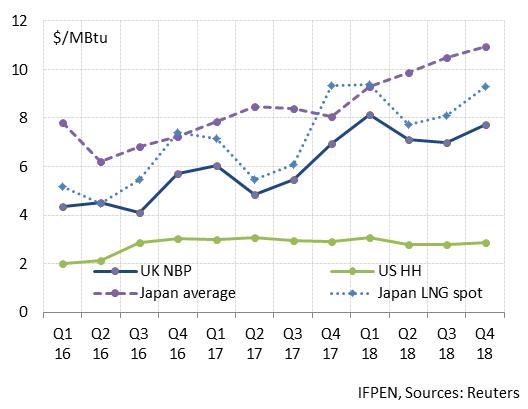
 

Gas price, by quarter: U.K., Japan and the U.S. Gas price, by quarter: U.K., Japan and the U.S.


Spot price ($/MBtu and €/MWh)


Spot price

LNG Pricing: Is US LNG competitive in North East Asia?

Out of the 8.3 Mt of US LNG exports recorded in the first 8 months of 2017, 2.37 Mt was exported to the North East Asian countries (29%). This represents a remarkable development given the fact that the US did not send any cargo to North East Asia in 2016.

On average, US LNG has turned out to be the most expensive LNG supply source in the region, priced 18% above the average regional LNG import cost. However, a country by country analysis shows that the US LNG was indeed priced close to the average price of LNG imports for China and even lower for South Korea and Taiwan. Japan is the only country in the region which pays a price for US LNG well above both its average cost of imports ($12.26 vs $8.04, a 52% extra-cost) and regional spot price indexes.

The rise in coal prices: Beijing policy drives EU coal-to-gas switching

Despite a decline in global coal demand for the second consecutive year, international steam coal prices doubled in 2016. This massive rise may seem paradoxical; in fact, it responded to market fundamentals: a tightening of the international market due to an unexpected surge in Chinese coal imports and the inability of exporters to meet this sudden increase. The surge in Chinese imports was not due to increasing demand – Chinese coal consumption in 2016 fell for the third year in a row– but to domestic production restrictions mandated by the Chinese government from April 2016. To remove excessive and outdated capacities in the domestic coal sector, that weighed on domestic coal prices, the government required coal mining companies to cut operating days from 330 to 276 a year. The new regulation led to a fall in coal production, shortages of coal and a steep increase in domestic coal prices, forcing power utilities to turn to the international market. However, after five years of low prices and reductions in investment, exporters were not able to respond to this sudden demand and international prices increased to clear the market.