
From supply wave to supply gap: LNG market under Gulf disruption

By Irina Mironova for Cedigaz

Recent attacks on Qatar’s LNG infrastructure have taken two liquefaction trains out of service, removing approximately 12.8 mtpa (~17% of Qatar’s capacity) for an estimated three to five years.

This development intensifies the disruption seen in recent weeks, centred on the effective closure of the Strait of Hormuz, which normally carries around 20% of global LNG trade. Maritime constraints have already translated into both physical supply losses and logistical bottlenecks, with LNG carriers unable to exit the Gulf and export flows significantly constrained.

The crisis has now shifted into a structural supply loss, extending beyond the short-term disruption scenarios considered earlier.
Mozambique LNG: A Restart for Africa’s LNG Ambitions

Irina Mironova for CEDIGAZ

TotalEnergies and its partners – Mitsui, ENH, Bharat Petroleum, Oil India, ONGC, and PTTEP – have lifted the four-year force majeure on the long-delayed Mozambique LNG project. The $20 billion onshore venture in Cabo Delgado province, suspended after the 2021 insurgent attack, returns to the spotlight as one of Africa’s most ambitious LNG developments.

CEDIGAZ 2035 LNG Outlook – New projects needed after 2023

GLOBAL OVERVIEW

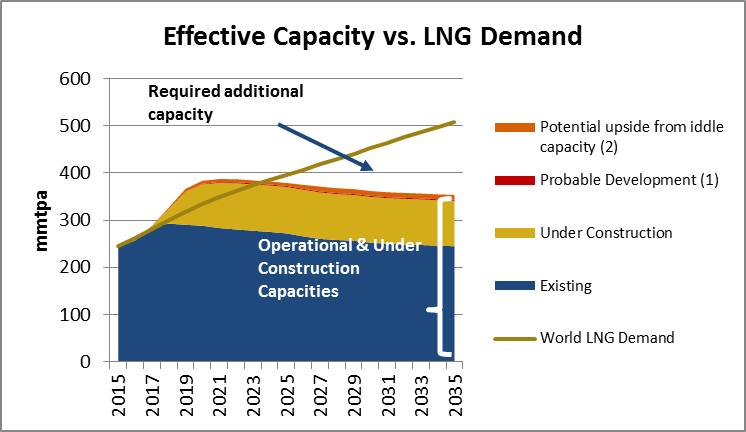
  • Total effective capacity[1] is expected to increase significantly from 244 mmtpa in 2015 to 387 mmtpa in 2021 (+60%). Subsequently, effective capacity from facilities currently operational or under-construction should progressively decrease to reach 354 mmtpa by 2035 due to the aging of some assets and gas shortages in some producing countries. Demand will struggle to keep up with supply ramp-up at the beginning of the projection period and an over-supply situation should prevail. Rebalancing of the market is not expected before 2023, or even 2024 if probable developments (Fortuna FLNG) and potential upside from currently idle capacity (Egypt, Yemen) are taken into account. After that, the continuous growth of the LNG market will leave a large margin for the implementation of new projects.

    Effective Capacity vs LNG demand


    Effective Capacity vs LNG demand

    (1): Equatorial Guine      (2): Egypt, Yemen

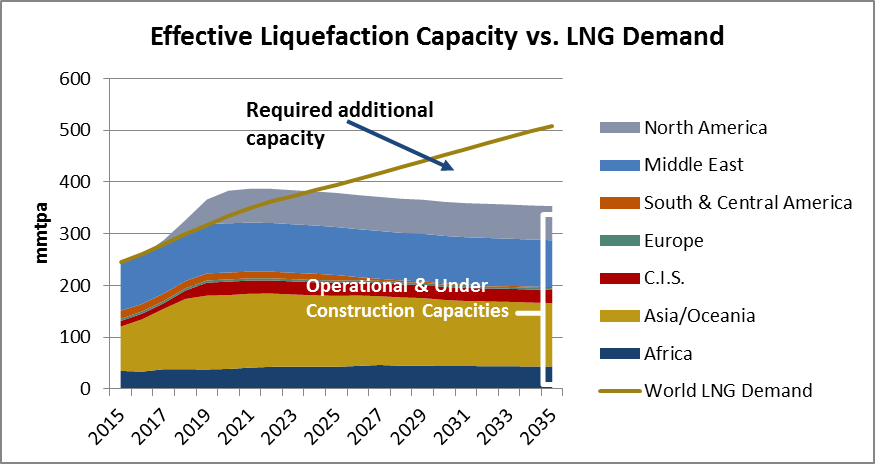
  • Three main regions stand out: Asia-Oceania, the Middle East and North America. Effective liquefaction capacity in Asia-Oceania is expected to see a significant increase reaching a plateau between 2019 and 2023 and then decreasing until 2035. Capacity in the Middle East remains broadly stable throughout the period with just over 90 mmtpa of effective liquefaction capacity, although Qatar’s recent announcement calling for a 30% production growth to 2024 could change the game. In North America the stepping up of United States’ LNG will constitute a major upheaval, with a total liquefaction capacity expected to reach 66 mmtpa by 2021 (Canada included).
  • LNG capacity in Africa and the CIS should remain stable after a slight increase at the beginning of the projection period. Stability is also expected in Europe, while effective capacity will gradually decrease in South & Central America due to growing constraints on feedstock as Trinidad and Tobago’s gas reserves dwindle.

    Effective liquefaction Capacity vs LNG demand by region


    Effective liquefaction Capacity vs LNG demand by region