The new CEDIGAZ report, U.S. Natural Gas Update and Outlook*, analyzes the consequences of the oil price decline on the U.S. oil and gas sector as well as the implications for production and hydrocarbon prices.
The oil price decline has left American producers in a situation like that of 2009 following the collapse of the Henry Hub gas prices. At the time, shale gas production was growing fast but demand was depressed due to the effects of the subprime mortgage crisis. Producers reacted by redirecting their investments towards liquid-rich deposits (containing oil or natural gas liquids) and were thus able to benefit from the oil price recovery. This strategic reorientation did not penalize gas production, which continued to grow, thanks to the gases associated with oil production which, in recent years, have been responsible for almost all growth in gas production. Today, more than 50% of the shale gas produced in the United States comes from liquid-rich deposits. Consequently, any decrease in liquids production occurring in reaction to falling oil prices is bound to have major repercussions on domestic gas production.

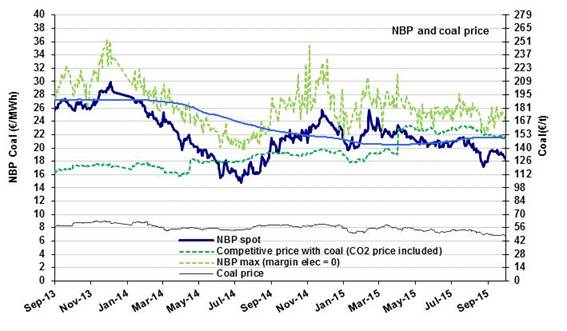 The NBP price for September averaged €19.2/MWh ($6.3/MBtu), down 8% compared to September 2014. The markets anticipated that, barring exceptional phenomena (weather or other), next winter’s average prices would be about the same: €19.5/MWh ($6.4/MBtu). For summer 2016, the price is expected to be under €18/MWh ($5.9/MBtu). Several factors account for this situation of prices that are historically low compared to the trends since 2011.