
THE GLOBAL GAS MARKET IN 2018

Natural gas supply and demand grew at their fastest pace since 2010 
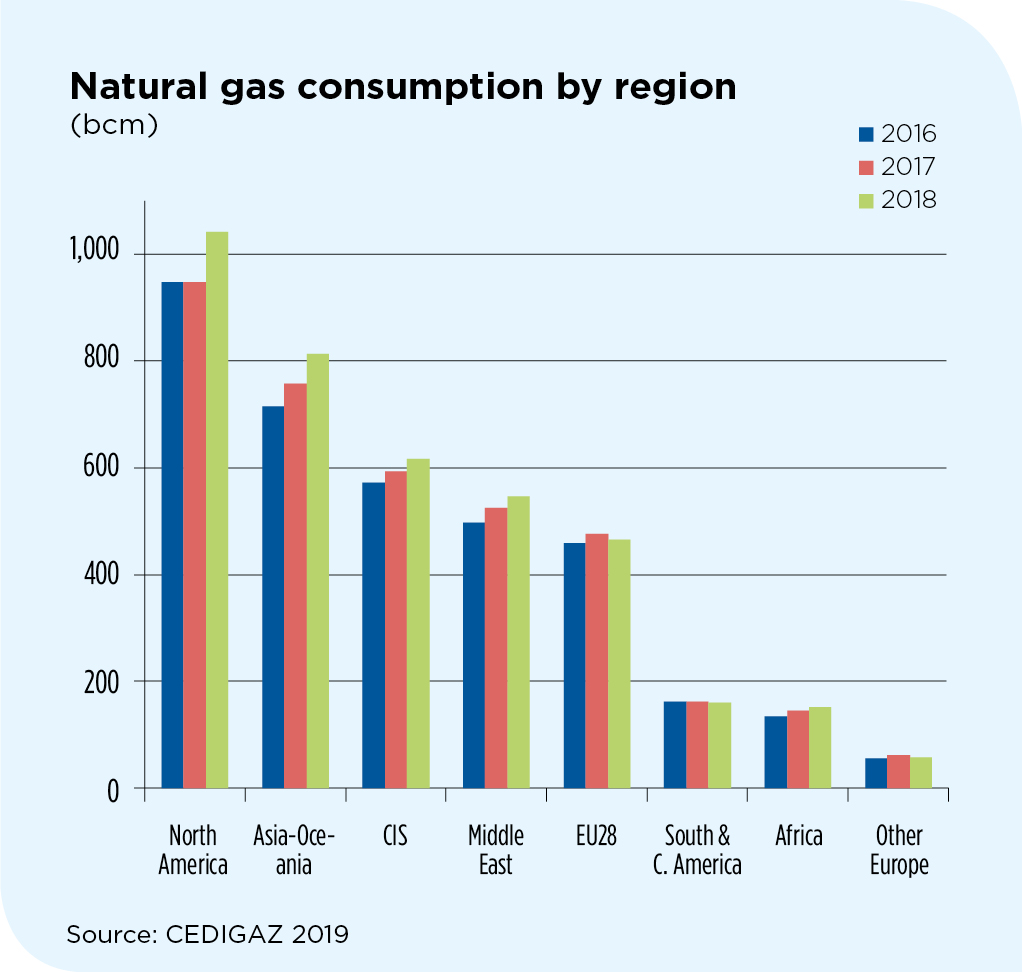
Natural gas consumption by regionAccording to CEDIGAZ report “The Global Gas Market – 2019 Edition”, 2018 has been a remarkable year for the global natural gas market.

Global natural gas demand surged 4.7% to 3850 bcm, driven by the US and China. The US was the standout performer, accounting for 45% of the global increase in both the consumption and supply of natural gas.

2018 marks the second year of strong growth of natural gas demand, after a 3.5 % rise in 2017. It also recorded the highest growth of gas demand since the post-crisis rebound of 2010.

This fast expansion was driven by the abundance of competitive gas supply, especially in the US and in Russia and by supportive energy and environmental policies, in some countries, particularly in China. Investment in transport infrastructure also contributed to bolster gas penetration in key markets.

China became the largest net importer of natural gas in the world before Japan. Chinese net imports jumped by 32% and accounted more than 80% of the global increase in net imports, once again highlighting the crucial role of China in absorbing global gas production.

Like in 2017, the expansion of natural gas demand was part of a substantial global growth in world energy demand, driven by a robust global economy and extreme weather conditions.

Strong gas demand growth in Asia contributed to a rise in market prices in key areas and prevented the formation of a global LNG bubble.
European LNG Imports slump in H1 2018

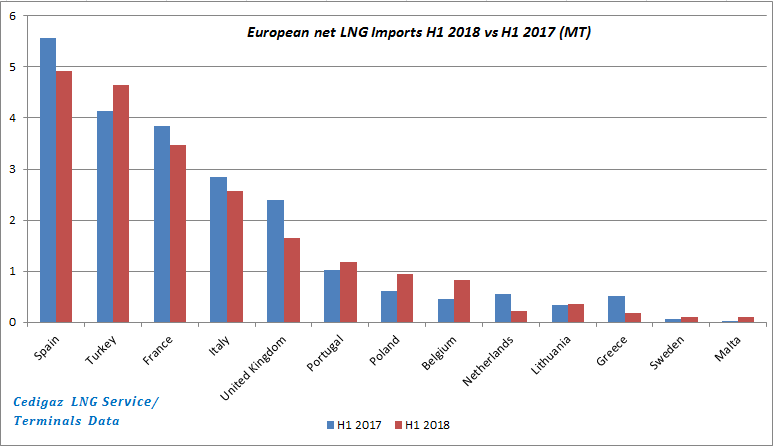
European net LNG imports in H1 2018 did not sustain the growth momentum which was seen in 2017 (nearly 5% Y-o-Y growth in H1 2017) as total LNG net imports fell by 5% (-1.21 MT YoY) to reach 21.2 MT. This trend was mainly the result of higher re-exports, which went up 1.1 MT YoY, and strong declines in net LNG imports in Spain, the UK and France.

In Southern Europe, net LNG imports were down 8.7% to 12.1 MT, as imports in France, Spain and Italy declined. LNG imports in Spain declined by 12 % (-0.65 MT), counterbalanced by pipeline imports from Algeria which grew 18% compared to last year. Spanish LNG imports from Peru were down by 0.88 MT and this was partially offset by increased purchases from Trinidad and Tobago (+0.67 MT). In France, re-exported volumes surged by 0.72MT YoY, resulting in a 10% decline (-0.4 MT) in net LNG imports. The re-exported cargoes from France landed mainly in Asia (China, South Korea, India) and the Middle East (Kuwait). In Italy, LNG imports were down by 10% (-0.28 MT) as the power sector gas demand weakened in H1 2018, while hydroelectric power generation increased. Portugal was the only Southern European country where LNG imports were up, albeit marginally (+ 0.15 MT).

European LNG Importers in H1’18


Figure 1: European LNG Importers in H1’18 (net of re-exports)

Global LNG trade continues strong momentum in Q1 2018

The global LNG trade in Q1 2018 sustained the growth momentum which was seen in 2017 as total LNG net imports grew by 9.6% (+6.89 MT YoY) to reach 78.7 MT. This strong growth was bolstered mainly by China (+4.83 MT YoY) and South Korea (+1.60 MT YoY) in North East Asia as well as India (+ 1.36 MT YoY) in South Asia. Bangladesh will also add to the regional demand marginally in 2018 as it started importing LNG in April this year. The Q1 2018 growth in China (+62% YoY) which resulted from coal to gas switching is adequate to maintain a 13% annual growth in 2018 even if the April-Dec’18 demand in China holds flat compared to the year earlier. South Korea surpassed China marginally in Q1 2018 in terms of net LNG imports. Domestic gas demand from the power sector in South Korea surged as 12 nuclear power units were offline. In India, LNG imports grew as a result of higher gas demand from the fertilizer sector and city gas distribution.