International Gas Prices – March 5 , 2015

NBP: Under temporary pressure

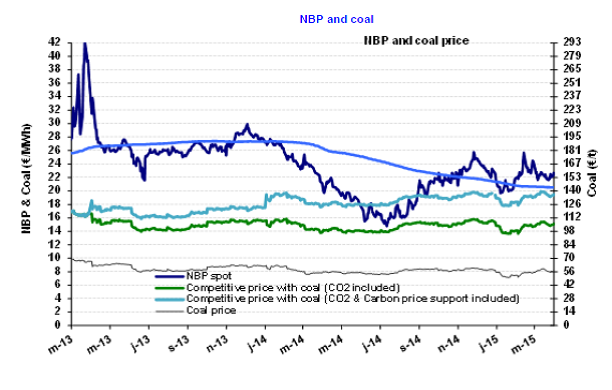
NBP and CoalThe NBP price averaged €23.4/MWh ($7.8/MBtu) in February, up nearly 14% compared to January. Two factors exerted upward pressure. First, taking the NBP to €25.7/MWh on Feb. 12, was the Dutch debate over Groningen and its level of production (66% of the country’s total) for 2015 and 2016. The latter was cut to 39.4 bcm from the initial target of 42.5 bcm, like in 2014. Proposals of 35 and 30 bcm were also heard. It was agreed to set the level at 16.5 bcm for first half 2015. Secondly, the negotiations between Russia and Ukraine in late February, with threats of cutting off gas deliveries, also gave cause for concern. The fact that a trilateral meeting took place and a prepayment was made in early March, even if it was small ($15 M for about 50bcm), slightly alleviated market pressure. In early March, the pressure lifted slightly and prices fell to €22.9 /MWh ($7.5/MBtu), 2% lower than in January. The market anticipated an average summer price of €21.6/MWh ($7/MBtu).

MEDIUM AND LONG TERM NATURAL GAS OUTLOOK

Natural gas will play a growing contribution in both OECD and emerging markets to meet the economic, environmental and security challenges of the world energy system. However, the future expansion of natural gas should not be taken for granted. Increased competition with coal in the power sector will need to be addressed while maintaining a gas price at a level compatible with the development of large capital-intensive projects. Only by resolving this conundrum can natural gas fully live up to expectations.

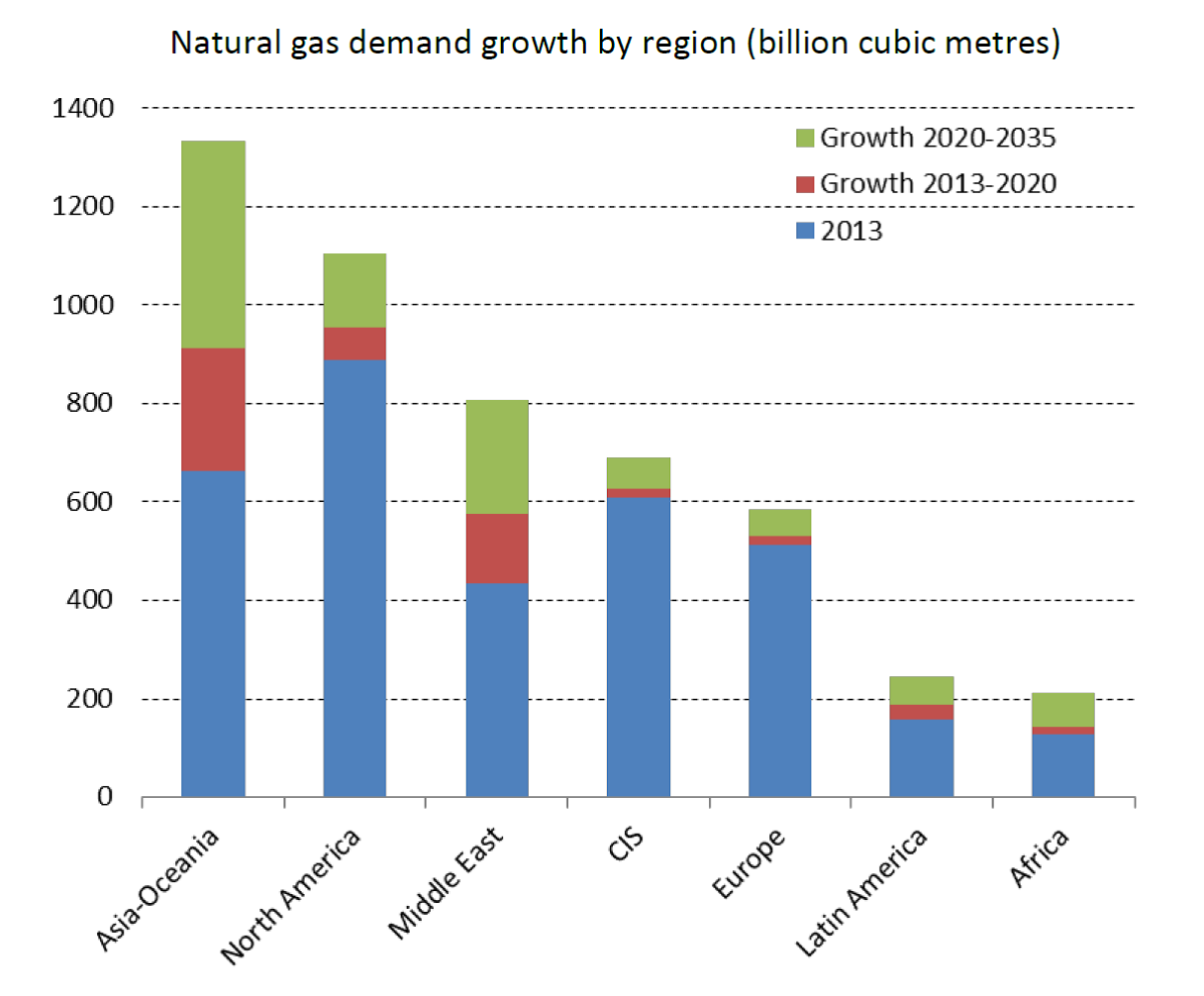
Gas demand growth is expected to remain strong to 2035, under the impulsion of the Middle East and China, where natural gas is making inroads in all consuming sectors

Natural gas demand➢ Energy efficiency gains will slow down both global primary energy and gas demand growths relative to the previous decade
➢ Global primary energy demand will grow by 1.3% per year and natural gas demand by 1.8% per year to 2035. Natural gas will increase its share in the global energy mix from 21% in 2013 to near 24%
in 2035
➢ Approximately 75% of the projected growth will come from emerging markets, driven by the economic growth and the displacement of oil in every main consuming sector
➢ Natural  gas  should  also  expand  in  the  power  sector  –  and,  to  a  lesser  extent,  in  the transportation sector – in OECD countries under the incentive of environmental & climate policies
➢ Asia-Oceania and the Middle-East will drive demand, accounting respectively for 42% and 24% of global growth. Asia-Oceania will become the largest consuming area post-2020, led by China.
➢ In China, the future growth of natural gas will be driven by the implementation of an energy and environmental policy aiming to shift away from coal to cleaner fuels in the long term

International Gas Prices – February 5 , 2015

NBP: under temporary pressure, hovering at about $7/MBtu

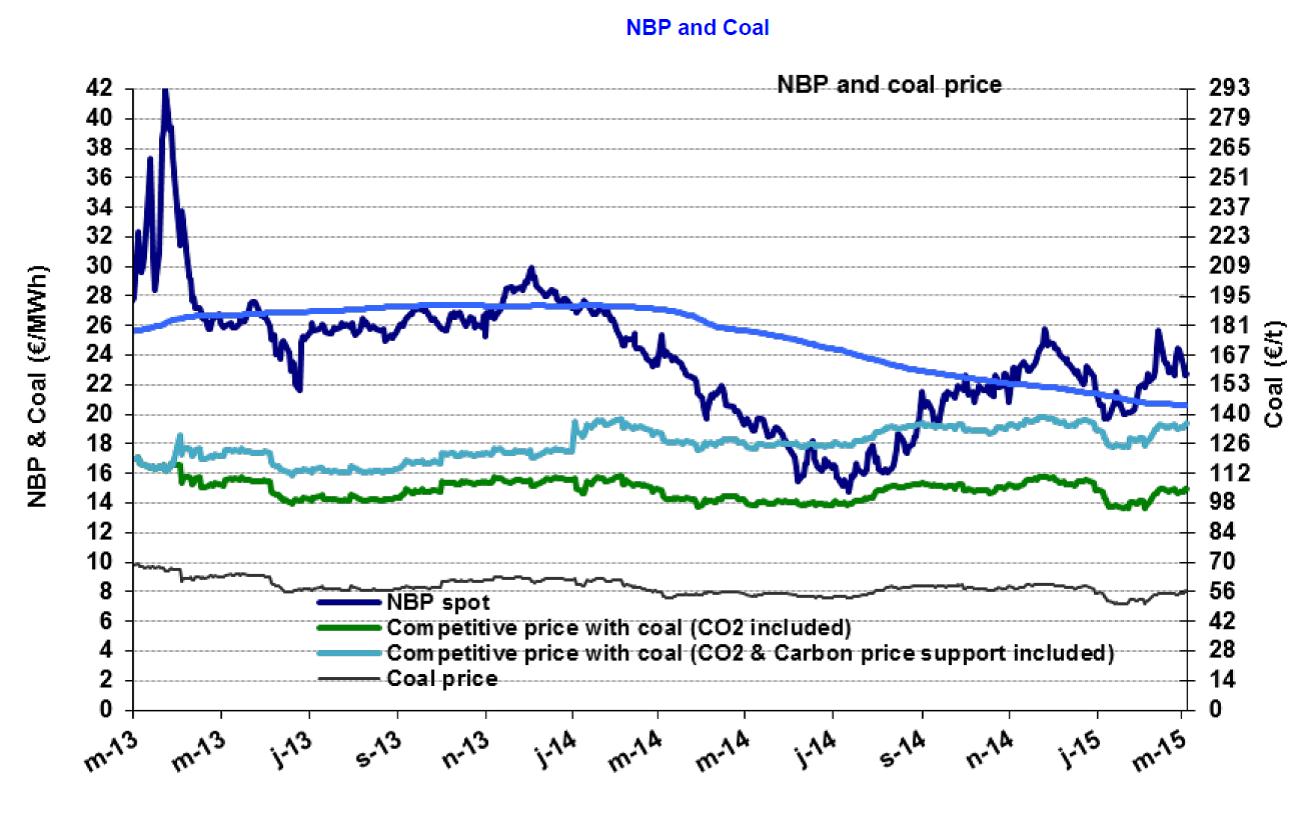
NBP and coal priceDue to falling temperatures and delivery constraints, the NBP price has been oriented upwards since the end of January: it rose by more than 9% over two weeks, to about €22/MWh ($7.4/MBtu). However, the overall trend is down. The monthly average for January was €20.5/MWh ($7.0/MBtu), i.e. 11% below the average for December. This general movement is reflected in the 12-month moving average, which is now standing at €20.5/MWh ($7.0/MBtu) after steadily falling since last March (€27/MWh ;$10.8/MBtu). The market is anticipating lower prices in the upcoming months: €19.9/MWh ($6.7/MBtu) next summer and €22.8/MWh ($7.7/MBtu) next winter. These trends are consistent with the current conditions on the market, marked by less pressure on the LNG, coal and oil markets. Given the quantities of LNG available in Asia, the spot prices are coming into convergence with the European market at around $7/MBtu, which encourages the purchase of European LNG. As for oil, the upward shift in the oil price observed since February 2 won’t be changing the downtrend on the natural gas market.