CEDIGAZ 2035 LNG Outlook – New projects needed after 2023

GLOBAL OVERVIEW

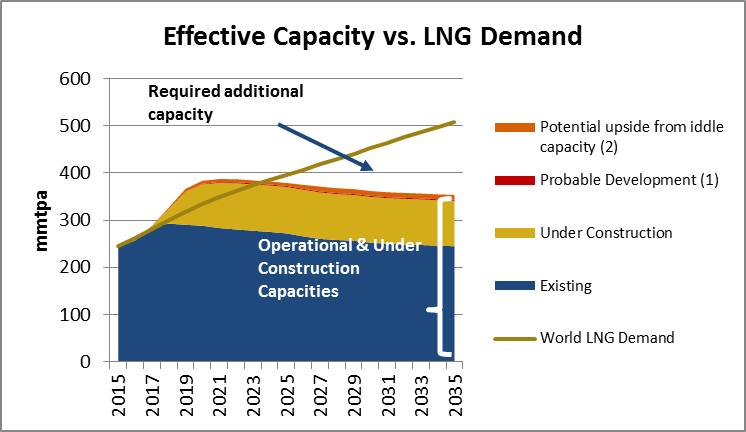
  • Total effective capacity[1] is expected to increase significantly from 244 mmtpa in 2015 to 387 mmtpa in 2021 (+60%). Subsequently, effective capacity from facilities currently operational or under-construction should progressively decrease to reach 354 mmtpa by 2035 due to the aging of some assets and gas shortages in some producing countries. Demand will struggle to keep up with supply ramp-up at the beginning of the projection period and an over-supply situation should prevail. Rebalancing of the market is not expected before 2023, or even 2024 if probable developments (Fortuna FLNG) and potential upside from currently idle capacity (Egypt, Yemen) are taken into account. After that, the continuous growth of the LNG market will leave a large margin for the implementation of new projects.

    Effective Capacity vs LNG demand


    Effective Capacity vs LNG demand

    (1): Equatorial Guine      (2): Egypt, Yemen

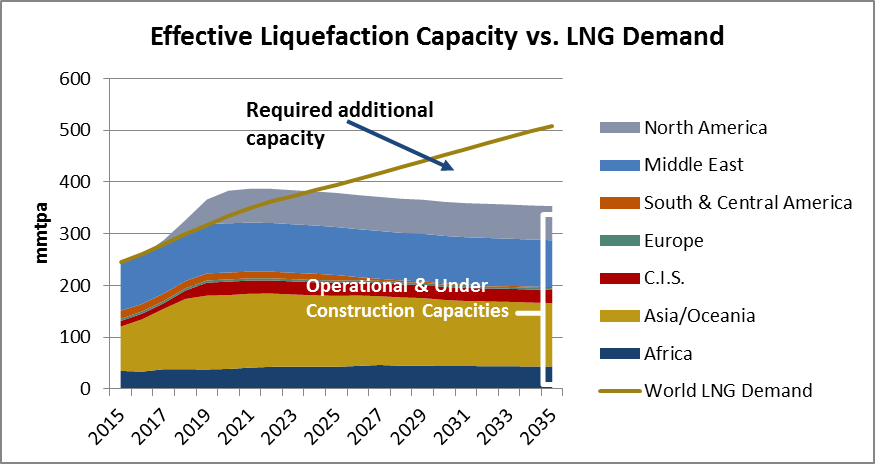
  • Three main regions stand out: Asia-Oceania, the Middle East and North America. Effective liquefaction capacity in Asia-Oceania is expected to see a significant increase reaching a plateau between 2019 and 2023 and then decreasing until 2035. Capacity in the Middle East remains broadly stable throughout the period with just over 90 mmtpa of effective liquefaction capacity, although Qatar’s recent announcement calling for a 30% production growth to 2024 could change the game. In North America the stepping up of United States’ LNG will constitute a major upheaval, with a total liquefaction capacity expected to reach 66 mmtpa by 2021 (Canada included).
  • LNG capacity in Africa and the CIS should remain stable after a slight increase at the beginning of the projection period. Stability is also expected in Europe, while effective capacity will gradually decrease in South & Central America due to growing constraints on feedstock as Trinidad and Tobago’s gas reserves dwindle.

    Effective liquefaction Capacity vs LNG demand by region


    Effective liquefaction Capacity vs LNG demand by region
The reshaping of the global LNG market

The ramp of new LNG production accelerated in 2016 when 16 million tons of new LNG supply were added to the market, representing a 6.8% annual growth. This was the highest growth rate recorded since 2011 but it only represents the very beginning of the LNG wave that is about to hit the market. There are still about 110 mmtpa of new capacity under construction that are expected to start producing from now to 2020-2021. This equates to around 42% of the 2016 LNG demand that would come on line in a very short time, raising the question of the capacity of the market to absorb the additional volumes and at what price.

2015 saw the unexpected decline of LNG demand in Asia. This unsettling development had two main reasons. First the end of the Fukushima-driven growth in the JKT countries, especially in Japan, together with energy conservation policies led to a strong decline of LNG demand in the historical Asian markets. Second the collapse of Chinese LNG demand growth due to price issues and the competition with piped gas. On the bright side, 2015 witnessed the emergence of new buyers (Egypt, Jordan and Pakistan) – that were able to take advantage of the low price environment, thanks to the flexibility offered by FSRUs -, as well as accelerated growth in the MENA region.

Does LNG have a long-term future in the United Arab Emirates?

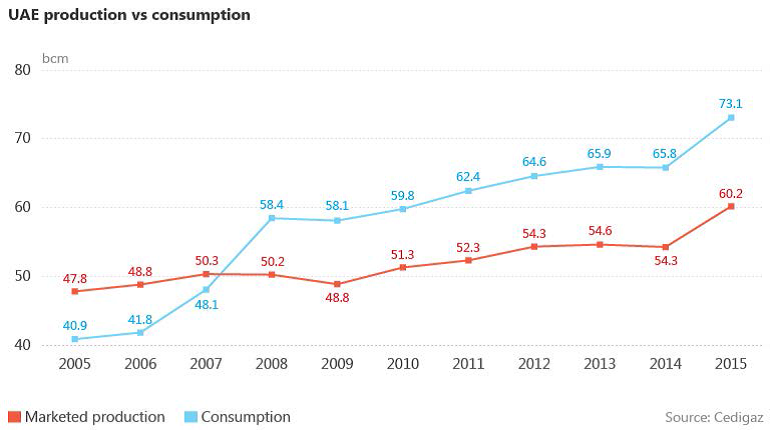
UAE production vs consumptionThe United Arab Emirates (UAE) is one of the world’s longest-established LNG exporters. But despite holding the world’s sixth largest gas reserves, LNG imports into the federation increased at an impressive rate since 2010, when the Jebel Ali floating terminal in Dubai started up. With gas representing more than 90% of the power fuel mix, LNG purchases have been key to fill a widening supply deficit in order to match rapidly growing gas-to-power demand. Today, LNG remains at the heart of the UAE’s strategy to meet rising energy consumption and support economic and industrial expansion in times of reduced oil income and budgetary constraints. Cedigaz’s latest report examines the risks and opportunities inherent to this strategy and asks whether it is viable in the medium to longer term.